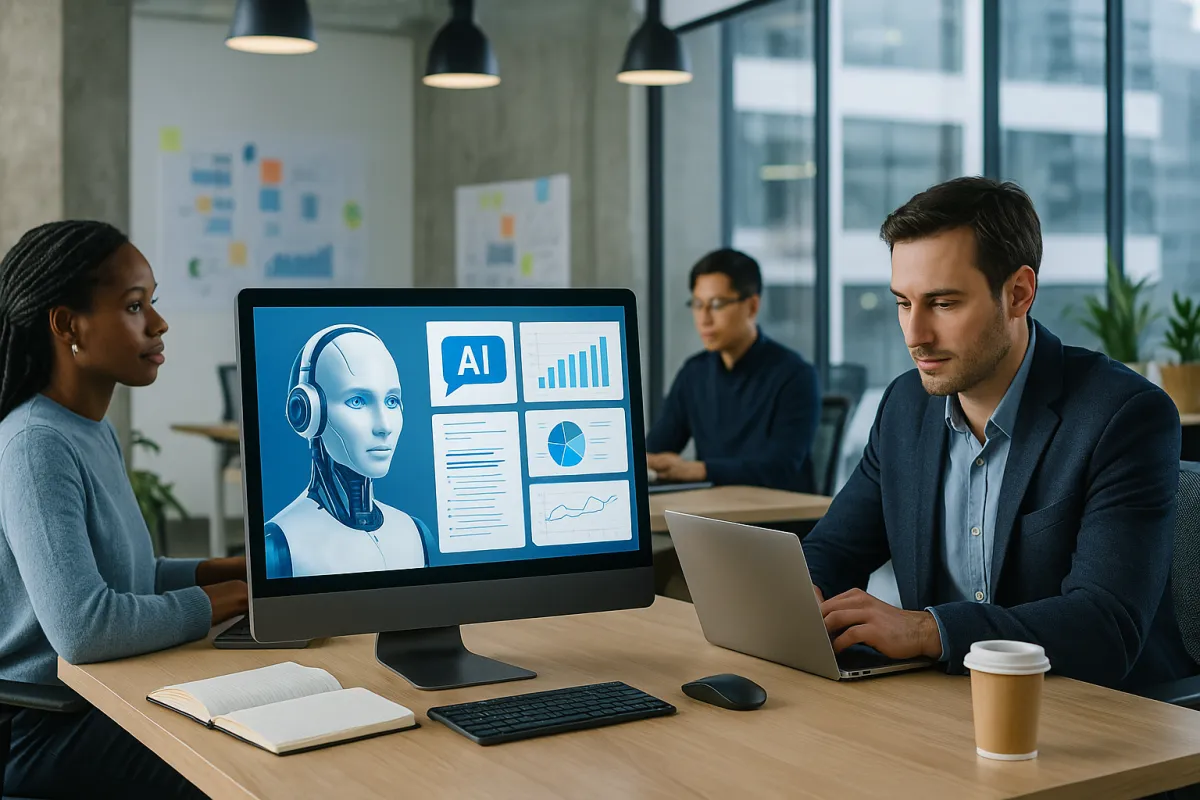
AI at Work in 2026: How Intelligent Tools Are Transforming Productivity
Introduction: A New Era of Work
As we step into 2026, the way we work is changing faster than ever before. Across industries, artificial intelligence (AI) has become a vital partner in daily operations, helping teams work smarter, faster, and more creatively.
AI is no longer a futuristic buzzword. It’s the backbone of modern workplaces, powering communication tools, data analysis, marketing automation, and decision-making. According to a PwC report, AI could contribute up to $15.7 trillion to the global economy by 2030, with productivity gains driving nearly half of that growth.
Simply put, AI at work isn’t replacing humans, it’s amplifying human potential.
Smart Assistants: The New Coworkers
Virtual AI assistants have evolved far beyond simple chatbots. Tools like ChatGPT, Microsoft Copilot, and Google Gemini are now integral parts of the modern workplace. They summarize long reports, schedule meetings, draft proposals, and even brainstorm marketing ideas, tasks that used to take hours can now be done in minutes.
For instance, creative professionals use AI to generate outlines, analyze customer sentiment, and refine brand messages. Instead of spending time on repetitive work, teams can focus on innovation and strategy.
A great example is Notion AI, which helps writers structure ideas, or Jasper, which assists marketers in crafting persuasive campaigns. These intelligent tools are not just time-savers, they’re productivity partners.
Automating Repetitive Tasks: The Real Game-Changer
Automation is where AI tools truly shine. Repetitive tasks like data entry, report generation, or email sorting can now be handled efficiently by platforms such as Zapier, UiPath, and Make.com.
These systems connect different software tools, allowing processes to run seamlessly with minimal human input. For instance, a marketing manager can automate lead tracking, social media posting, and performance reporting, all with the help of AI.
According to a McKinsey study, automation could boost global productivity by up to 1.4% every year through 2030. That may sound small, but across industries, it represents trillions in value creation.
Automation doesn’t eliminate jobs, it eliminates monotony, freeing humans for creative, strategic, and empathetic work.
Smarter Decision-Making with Data and AI
In a world flooded with data, decision-making is only as good as the insights you can extract. That’s where AI-powered analytics step in. Machine learning algorithms can analyze massive datasets, detect trends, and forecast outcomes with remarkable accuracy.
From sales forecasting to employee performance tracking, AI is transforming data into actionable intelligence. Tools like Tableau AI and Google BigQuery are making it easier for non-technical teams to visualize and interpret complex data.
The benefit is clear: businesses can make faster, smarter, and more confident decisions, often in real time.
The Creative Power of Collaboration: Human + AI
There’s a common misconception that AI threatens creativity. In reality, AI is becoming one of the best creative collaborators out there.
Designers use tools like Adobe Sensei to generate design variations and improve visual workflows. Writers rely on AI to fine-tune tone, structure, and readability. Developers use AI copilots to suggest better code and spot errors instantly.
Instead of replacing imagination, AI at work is helping humans push creative boundaries. It’s like having a second mind, one that can instantly generate options, ideas, and insights to enhance the creative process.
Balancing Innovation and Humanity
Of course, the growing presence of AI raises valid questions about privacy, ethics, and employment. To integrate AI successfully, companies must focus on transparency and education, helping employees understand and adapt to these intelligent systems.
The most successful organizations will be those that embrace AI as a partner, not a replacement. When machines handle logic and repetition, humans can focus on what they do best: empathy, storytelling, leadership, and innovation.
Conclusion: Building the Future of Work, Together
The workplace of 2026 is collaborative, data-driven, and powered by AI. Intelligent tools are transforming productivity, reshaping roles, and opening new possibilities for every professional.
The future isn’t AI versus humans, it’s AI with humans. Together, we’re creating a world where work becomes smarter, faster, and more fulfilling.
AI at work isn’t just about efficiency, it’s about empowerment. And the companies that embrace it today will define the next decade of innovation.
Tags:
AI at Work, Artificial Intelligence, Future of Work, AI Productivity, Digital Transformation
Image Alt Text:
AI assistant collaborating with human employees in a futuristic digital workspace
